by Vittorio Bongiorno
Published on Il Foglio, 17.10.2026
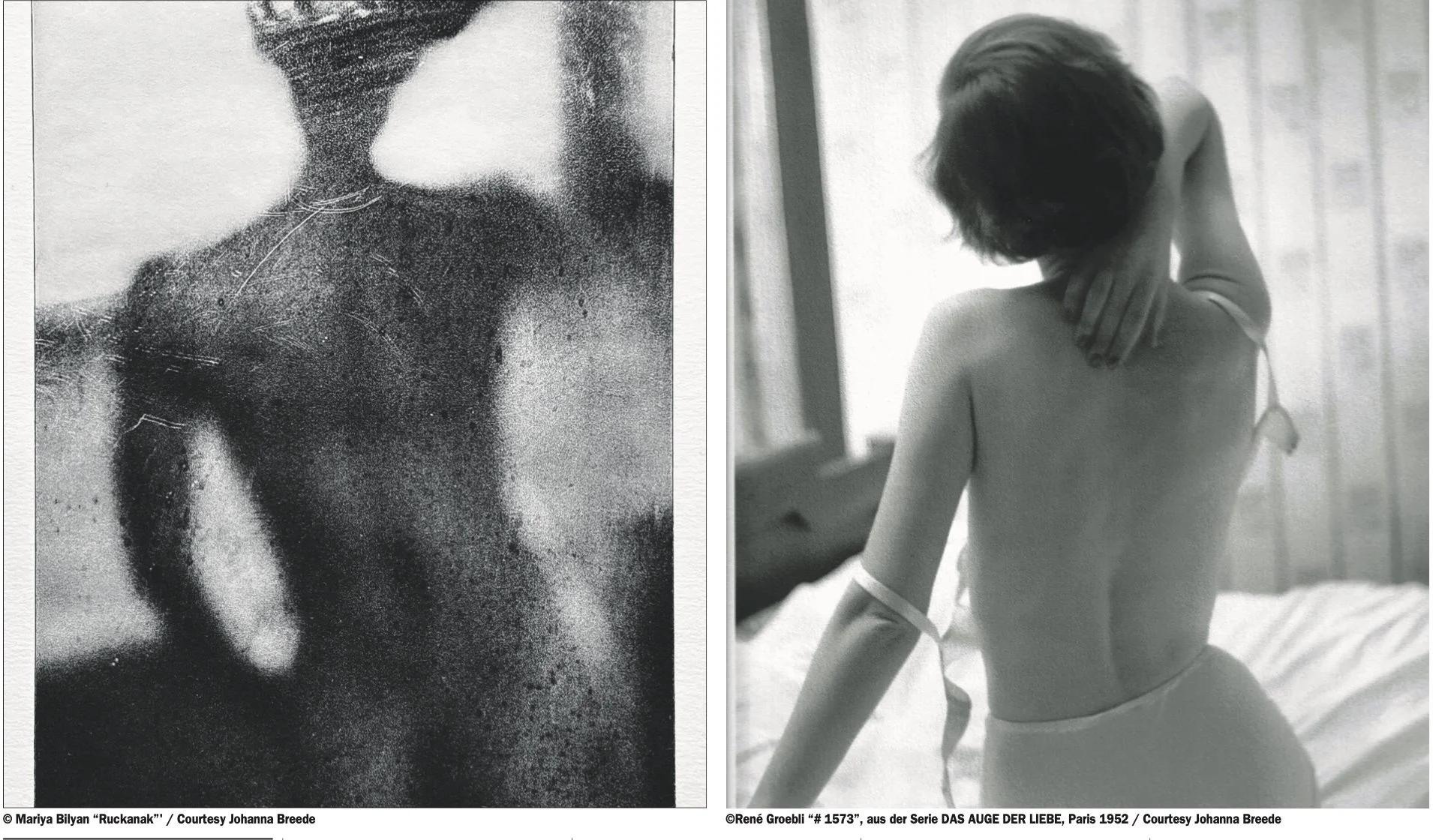
Is meeting someone in Berlin and falling in love love at first sight or a kind of chemical destiny? “Wahlverwandtschaften,” or elective affinities, are the dream behind a thirty-year-long photography exhibition that is finally taking shape through the work of twenty-four photographers—fourteen women and ten men—who, without ever meeting or knowing one another, captured the same image on different continents, in different eras, and in different styles. Welcome to Berlin, at Johanna Breede PHOTOKUNST, the internationally renowned gallery for high-quality black-and-white photography, where the hostess and curator has created diptychs of literary memory, inspired by Goethe’s novel of the same name.
“I found myself in the fortunate position of being able to play Memory for a long time,” the hostess confides to ‘Il Foglio’ with refined elegance in her Art Deco parlor at Fasanenstraße 69, in a Berlin lulled by late summer along the quiet avenues of Charlottenburg, just a few days after the recent electoral upheavals. The group exhibition “Elective Affinities,” on view through October 23, brings together a diverse array of photographers, including, among others, the Germans Miriam Tölke and Stefan Moses, the Ukrainian Mariya Bilyan, the Pole Marek Pozniak, the Algerian-Parisian Isa Marcelli, the American Sheila Rock, the Chinese Songwen Sun-von Berg, and the Japanese Ayako Takaishi, alongside two great masters who have passed away: Herbert List and Robert Lebeck. Also featured in the exhibition are the two filmmakers Ulrike Ottinger and Wim Wenders, with two photographs from 1985 taken in Beijing and Tokyo: the director of “Perfect Days” is present alongside his wife, Donata, as is the other Japanese photography duo, Koichiro and Machiko Kurita.
Johanna Breede recounts the early days of her career as head of the photography department at the Villa Grisebach auction house, where she remained for eight years, and the sense of wonder mixed with amazement at holding originals by the most important photographers of all time in her hands: “It was an exciting and formative experience. On my desk I had prints by Irving Penn, Saul Leiter, Imogen Cunningham, Steichen, Edward Weston, Renger-Patzsch, Ansel Adams, Cartier-Bresson, Dorothea Lange, and many others. I loved this work and would read between the lines of the photographs to discover affinities, and even then, the desire to create a dialogue among the subjects based on elective affinity had already emerged within me. When I later opened my small gallery, I carried that desire, that dream, with me. But sometimes I would sell a photograph, and as a result, I would be missing the pair needed to create a dialogue in the exhibition ‘Elective Affinities’.” Today, this secret dialogue unfolds with beauty and delicacy under the curious gaze of the cultured gallery owner, evoking gestures, shadows, and situations described in the novel of the same name, a masterpiece of German literature.
In 1808, Johann Wolfgang von Goethe—a great poet, writer, philosopher, and scientist—borrowed the concept of “elective affinity” from chemistry and alchemy, fields in which he was a leading scholar, to develop his theory of “Wahlverwandtschaften.” He thus described the uncontrolled and entirely random attraction that causes certain substances to break away from existing structures and recombine with others, driven by deeper and equally uncontrollable forces. Goethe is sixty years old, at the height of his artistic career, and—despite being married—he literally loses his head over the eighteen-year-old Wilhelmine Herzlieb, known as Minna: he first dedicates a series of sonnets to her, then even gives her a gold ring, but the girl rejects him with a certain detachment. The Master’s heart shatters, but it magically recovers through the creation of the novel, in which he recounts that impossible love by crafting the character of Ottilia—the ethereal orphaned niece, modeled, of course, on Minna.
In the novel, the young woman arrives at the country estate of Carlotta and Edoardo, and Edoardo falls madly in love with her; then Carlotta loses her heart to the Captain, who is also a guest at their estate. Just like chemicals that recombine, the two couples break up and come back together in a whirlwind of uncontrollable passion and tragedy.
It is well known that Goethe’s tumultuous love life always fueled his writing, and this relentless intertwining of love and death transformed ‘Elective Affinities’ into what Thomas Mann—another restless giant of German literature—called “our greatest novel, a miracle of compositional happiness and purity, astonishing in its richness of relationships, its intimate connections, and its cohesion.” For Mann, Goethe was more than a spiritual father—he was a constant presence throughout the career of a writer who explored the decadence and eroticism of the bourgeoisie like no other. And in Johanna Breede’s exquisitely composed diptychs, we find precisely this: contrasts, forms, light, and gestures that seem to respond to intangible yet very evident spiritual resonances, much like those described in the novel.
“A beautiful foot is a great gift from nature, a grace that never fades,” declares the Count with great emphasis. He is one of Edoardo’s guests, infatuated with the foot of Carlotta, Edoardo’s wife, whose little shoe he would like to kiss with devotion. Immediately, the gaze turns to the corner wall at the entrance to the PHOTOKUNST gallery, where Yuriko Takagi’s shoes—photographed for a Comme des Garçons advertisement in 1995—make a playful nod to Donata Wenders’s “Red Shoes” from 2009. And what about the graceful feminine nape photographed in Paris by René Groebli in 1952, which is reflected in another nape photographed by Donata Wenders fifty-three years later, in Japan?
Goethe’s novel opens with Edoardo and Carlotta grappling with the renovation of their estate’s park—with trees to be cut down and new plants to be added—a perfect metaphor for what the four characters—Edoardo and Carlotta, their niece Ottilia, and the Captain—will find themselves experiencing as their lives take on a new form. Goethe writes this in the opening lines of the novel: “To the right, the valley opens up, and once past the vast expanses of trees, the gaze is lost in a crystal-clear distance.”
With the same gaze focused on the purity of white, Johanna Breede must have juxtaposed the “Frozen Tree”—photographed in Norway by Jens Knigge in 2015—with the identical bare tree photographed by Koichiro Kurita in Japan in 1987. And again: re-reading the scene in which, returning from a walk near the old mill, Edoardo turns to look at Ottilia, who “followed him without fear or hesitation, leaping lightly and with perfect balance from stone to stone; it seemed to him as if he were seeing a celestial being hovering above him,” our gaze rests on the two photographic collages by Isa Marcelli (2021) and Miriam Tölke (2022) which, one in Paris and the other in Berlin, mysteriously and enchantingly give shape to the face of the same girl.
Those most surprised by these uncontrolled and uncontrollable elective affinities are the artists themselves. Mariya Bilyan describes the gallerist as “a magnet for like-minded artists; it was her brilliant eye that brought us all together so easily. “Today, that’s a rare occurrence.” Donata Wenders shares this view: “What a precious gift Johanna has given us!” says the German photographer of the gallery owner-alchemist’s work. “Finding my images—which I know so well—placed side by side like brothers and sisters with other photos by my colleagues was like meeting family members I hadn’t known before. What a joy and what a sense of belonging.”
Berlin-based artist Kathleen Alisch conveys the same feeling, thrilled to have her work displayed alongside that of Japanese photographer Koichiro Kurita: “It feels like an extension of my intense periods in Kyoto. Perhaps it’s a deeply rooted interplay between chance and intention, which ultimately brought us together in his darkroom in Japan and now on this wall.”
Chemistry and chance are the surprising paradox that underpins the entire exhibition: photography captures the moment—“there are only coincidences,” said Henri Cartier-Bresson in 1971—and yet it seems to have its own predestination. Very different photographic styles connect with one another not as chance encounters, but as if they already knew each other before meeting on Johanna Breede’s walls.
“In fact, for me, elective affinity is above all a dialogue within a completely unforeseen and unexpected situation,” adds Donata Wenders, “born of something that drew me in, that I couldn’t explain, and that I could never have planned in advance.” “Sometimes an image appears in my mind even before I encounter the subject in reality,” says the Paris-based Japanese photographer Ayako Takaishi, “it almost seems to me as if the photograph already existed before the moment I took it, as if time had folded in on itself for an instant.”
“When I started taking photographs,” says Isa Marcelli, “I realized right away that I wasn’t looking for technical perfection, but rather that I preferred the traces of a certain imperfection. I’m interested in the idea of vulnerability: we are unique and singular, but also fallible human beings. And when I take a photo, I’m no longer solely responsible—chance becomes my ally.”
Chance also plays a major role in the ink drawings of Songwen Sun-von Berg, who was born in Shanghai but lives in Berlin: “When I arrived at the opening, I was surprised to see my drawings next to the photos by Jens Knigge and Ayako Takaishi. I didn’t know them before, and all three of us had worked completely independently.” Jens Knigge also emphasizes how deep his connection to chance is, referring to his photograph taken on the frozen Lake Baikal in Siberia: “I was struck by the deep bond that the local population—predominantly Buddhist—forms with the lake’s waters. I photographed ice formations and abstracted the images by inverting their tones, thus creating space for free interpretation and imagination.”
Time and space, therefore, break down and reassemble on the walls of Johanna Breede’s gallery, and the photographic memory of these extraordinary artists now becomes a collective unconscious—one that cannot be controlled or planned.
And during the very same days when photographers who have never met are drawn to one another, two musicians from vastly different backgrounds also experience an equally uncontrollable elective affinity that produces music perfect as the ideal soundtrack for this dreamlike exhibition: Anushka Chkheidze and Robert Lippok, she 29, he 60, are releasing their second collaborative album, “The Sky Was Out of Tune,” a dreamlike 25-minute piece published by the prestigious Morr Music label.
“It was composed for the Festival of the Future at the Neue Nationalgalerie in November 2025,” says Lippok, “we wanted to create something dense yet unstable, in which noise, harmonies, and melodies would coexist, yet each would retain its own identity.” Anushka Chkheidze, born in Tbilisi, Georgia, is considered one of the most promising talents on the contemporary Caucasian music scene, while Robert Lippok has written some of the most significant chapters in Berlin’s musical history: together with his brother Roland, while they were still living in the former GDR, he created that wild sonic blend of electronic, post-rock, and ambient music, first with the duo “Ornament und Verbrechen”—named after the title of the famous essay written in 1908 by architect Adolf Loos—and later with the brilliant To Rococo Rot.
“We met in Tbilisi in 2019, during an improvisation session at an ambient music workshop. Anushka played the piano, and within a minute, I knew I wanted to work with her. The clarity, simplicity, and beauty of the chords and melodies she played immediately touched my heart,” says Lippok, as we stroll through the intersection of Kreuzberg and Neukölln—the two most creative and multicultural neighborhoods in this city that never seems to sleep.
For him, too, the image Goethe borrows from chemistry fits perfectly with his conception of music: “The collaboration with Anushka was completely unplanned, and yet from the moment we started, it seemed inevitable, as if our sounds already knew each other in some way before they met. That’s why I hold dear the phrase by Donna Haraway (the American feminist theorist, ed.) ‘make kin’—to create kinships, alliances, and mutual responsibility.”
The “Elective Affinities” showcased by Johanna Breede reveal the wondrous enigma of connections between human beings, just like the music produced by Chkheidze and Lippok. And, as Goethe writes in the final pages of his novel: “If one of the two had been confined to the far end of the house, the other, instinctively, without meaning to, would have gradually drawn closer to him. Life was an enigma to them, the solution to which they could find only together.”
https://photography-now.com/exhibition/178511