by Vittorio Bongiorno
published in Il Foglio, November 14, 2026
- translated with AI -
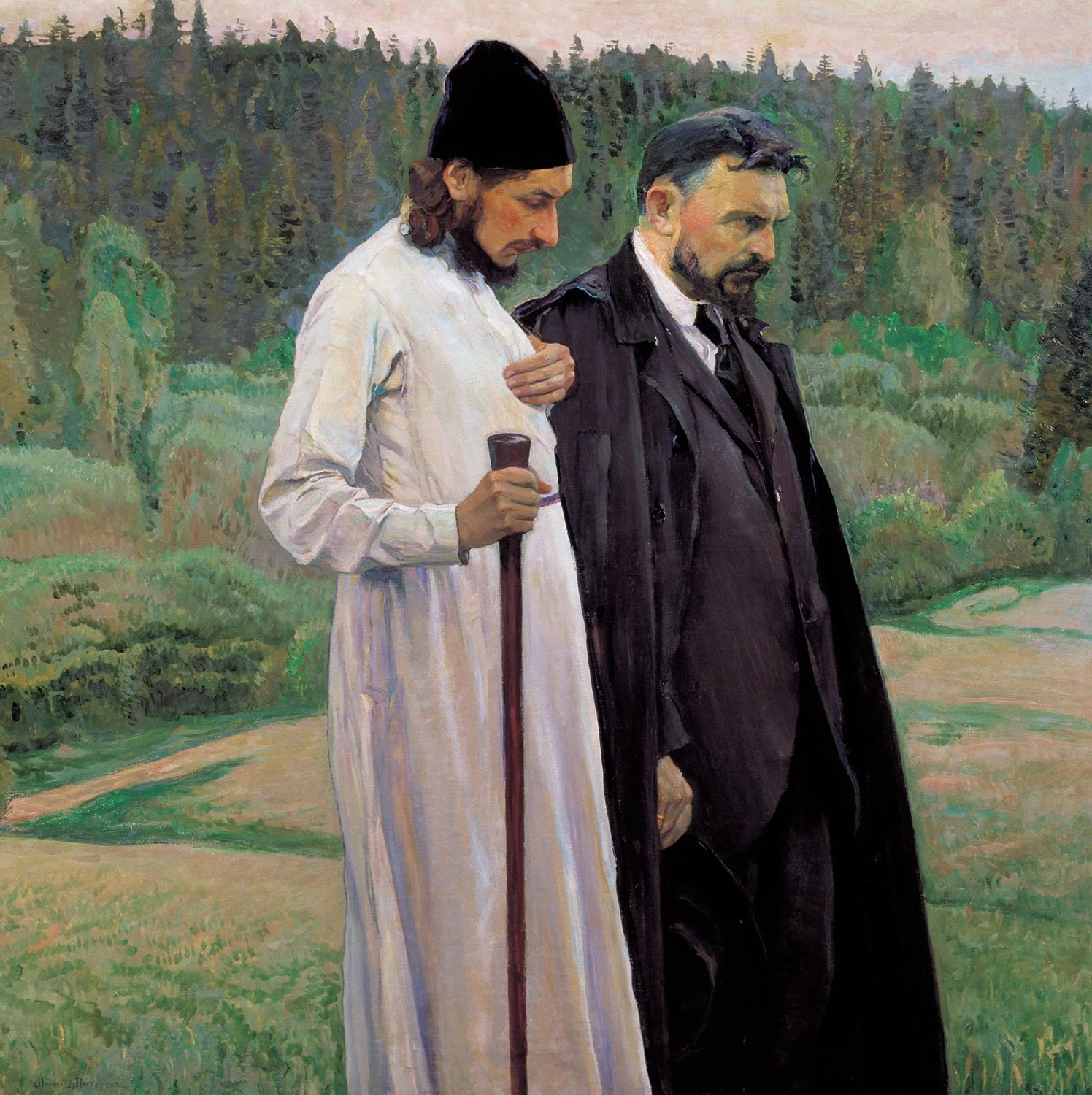
Mikhail Nesterov, ritratto di Pavel Florenskij e Sergei Bulgakov
In Euclidean geometry, two parallel lines never meet. Yet in the mind of Pavel Florensky—scientist, philosopher, and Russian Orthodox priest—the two lines meet at infinity, at a point that is none other than God. His lifelong studies—spanning religion, science, mathematics, and art—revolve around this insight. But in 1937, the Soviet regime, accusing him of a counterrevolutionary plot that never existed, sentenced him to death at the age of just 55 with a bullet to the back of the head.
Recounting the life of this Russian Leonardo da Vinci and confining it to the two-dimensionality of a page is a rather daunting task, given the vastness of his knowledge and the breadth of his cultural, literary, theological, mathematical, and even aesthetic interests. To honor his memory, the Venice Biennale has organized, as part of the second edition of the “Biennale della Parola”, a series of five theatrical evenings titled “The Pillar and Ground of Truth,” running from November 16 to 20. The production features a script and direction by Antonello Pocetti, music by Filippo Perocco, performances by actors Dario Aita and Alessio Vassallo, and sophisticated set design by Leonardo Sonnoli.
Pavel Aleksandrovich Florensky was born in 1882 in what is now Azerbaijan but moved with his family immediately to Tbilisi, Georgia. A scholar from a young age, at 17 he read Tolstoj’s “A Confession” and experienced a spiritual crisis that led him to write a stern and passionate letter to the great novelist—a letter that in all likelihood never reached its destination. Scholars believe the letter’s content was an accusation, in which the tormented young man sought advice from the heretical count on how an intellectual might navigate the “abyss of contemporary consciousness.”
Florensky probably criticized Tolstoj—whom he nevertheless regarded as a fellow sufferer—for the excessive moralism of his religious conversion. “It is likely that in that letter Florensky expressed his skepticism regarding the possibility of eradicating evil simply through good deeds and one’s own orientation toward the good,” Silvano Tagliagambe, a philosopher and physicist who is among the leading experts on the Russian thinker’s work, tells “Il Foglio”. In Russian culture, there was a significant debate between Tolstoj’s position and that of Dostoevsky, which was instead based “on the idea of an irrepressible struggle between good and evil that unfolds within the human heart, and on which the future of humanity depends,” Tagliagambe clarifies. He adds that, for Florensky, the root of all sin lies “in the exaltation of the self, of individuality, and thus in the denial of the importance of the relationship with others, which is constitutive of the person.”
If Pavel Florensky’s biography were limited to these major philosophical imperatives, it would be easy to recount, but that is not the case. The young scholar first enrolled in the Faculty of Physics and Mathematics at Moscow University, where he graduated in 1904 with a thesis titled “On the Particularities of Plane Curves as Places of Discontinuity.” It is interesting to note that the twenty-six-year-old Albert Einstein presented his theory of “Special Relativity” in 1905 and that of “General Relativity” in 1915, and although there was never any connection between the great scientist and the young scholar, the Russian studied the theory of relativity in depth to adapt it to his own purpose: to establish a dialogue between pure mathematics, relativity, and theology. He attempted this in 1922 in his treatise “Imaginary Numbers in Geometry,” where he analyzed the cosmological structure of the Divine Comedy by applying Einstein’s physical models of spacetime: how do Dante and Virgil, having reached the center of the Earth to meet Lucifer imprisoned in ice, manage to escape from Hell and reach Purgatory? In a stroke of genius that would put even director Christopher Nolan’s wildest visions to shame, Virgil turns himself upside down and, where he was previously descending, begins to ascend, traveling in the opposite direction. Dante is bewildered but follows suit, experiencing that reversal of gravity in a curved space that closely resembles a Möbius strip—or the finale of Nolan’s “Interstellar”. In 1908, Florensky earned his degree in theology, rejecting a prestigious academic career and taking his vows. In 1910, he married Anna Giacintova, and in 1911, he was ordained a priest.
“The law of identity is an absolute monarch,” writes Florensky in the book The Pillar and Ground of Truth, “but its subjects do not protest against its autocracy simply because they are bloodless spectres, devoid of real existence; they are not people but merely rationalistic shadows of people. This is Sheol, the realm of death.”
Although in the early years following the October Revolution Comrade Vladimir Ilyich Ulyanov—known as Lenin—was initially tolerant of intellectuals and scientists whose technical and scientific knowledge was indispensable for the development of the great Soviet state, Florensky soon became a troublesome figure for the regime. His first book, published in 1914, is one of the masterpieces of 20th-century mysticism and Orthodox theology, centered on Truth; it was later censored by the Soviet regime because it was deemed reactionary and obscurantist, and circulated clandestinely—a circumstance that delayed its dissemination in Europe for decades.
A group of the author’s disciples managed to secretly produce a phototypical reproduction of the work in Berlin in 1929, in a very limited number of copies. One of these copies found its way to Elémire Zolla: the great scholar and expert on mysticism engaged with the Russian thinker’s philosophy, rescuing it from oblivion and having it published in 1974—with an introduction of his own—by the publisher Rusconi; the text was finally rediscovered sixty years after its publication in Russia.
But the story is even more complex: in 1920, Lenin appointed Florensky to serve on the committee of GOELRO, the State Commission for the Electrification of Russia, the first major infrastructure project of the Bolshevik regime. The brilliant scientist arrived wearing a cassock, declaring that his expertise was embodied by a person who had made a deliberate choice—one expressed precisely by the garment he was wearing and which he had no intention of giving up.
“The first time I arrived in Moscow, on Red Square,” recalls Silvano Tagliagambe, “I was very struck by the slogan ‘Communism is Soviet power plus the electrification of the entire country,’ demonstrating the importance attached to this infrastructure project. And so, while Lenin allowed Florensky to wear the cassock—given his expertise in electrical engineering and mathematics—Stalin did not.”
Tagliagambe points out that Lenin had cautiously initiated a policy of compromise with so-called bourgeois knowledge and with all the members of the Tsarist Academy of Sciences, with a view to building something greater and more imposing. However, when the ruthless despot Stalin seized complete control of the party and overturned Lenin’s political line, he ushered in the era of the Great Purges and, in 1938, even had Nikolai Bukharin—one of the leading figures of the October Revolution, editor of Pravda, and described by Lenin in his will as “the party’s favorite son”—executed by firing squad. Tagliagambe, who recently dedicated the essay “The Source and the Mouth” (Mimesis, 2026) to Pavel Florensky, recounts this historical period with deep feeling: “Between 1934 and 1936, Stalin completely overhauled the organizational structure of all the main bodies and implemented a sort of hardening of the party line, clearly oriented toward proletarian science. And the scientist-theologian was one of the first victims of this shift. But he was not the only one.”
From 1927 to 1933, Florensky served as an editor for the Soviet Technical Encyclopedia, for which he wrote 130 entries, expressing a thoroughly modern perspective on technology that encompassed not only physics and mathematics but also biology. In the early 1920s, he was among the first to analyze the relationship between the human body and the artificial devices that humans can use to their advantage. “Essentially, he believed that technology is the key to better knowing and understanding our bodies,” adds Tagliagambe, “so there is a sort of extension of our bodies—through artificial means into the artificial world—that helps us better understand the body’s internal resources and potential. This is a very progressive stance, but also a highly atypical one for a man of the church.”
The Church, an institution to be dismantled in order to consolidate the totalitarian regime and the political and economic control of the new Soviet State, was plundered and, in many cases, destroyed on the orders first of Lenin and then of Stalin, because it was seen as the bearer of the famous “Opium of the People” coined by Karl Marx in 1844. Those who opposed this were shot or deported, and in 1922 alone, thousands of priests and monks were killed. Despite this, Florensky neither fled nor gave in; on the contrary, it was precisely during those years that he wrote his masterpiece, “Reverse Perspective”, an essay on visual theology concerning the representation of space in the figurative arts and in sacred icons.
Adriano Dell’Asta, professor of Russian language and literature at the Catholic University of Milan, writes in the afterword published on the occasion of the Adelphi reprint of “Reverse Perspective” that “it was indeed necessary to protect historical reality and preserve its memory and meaning in the face of a regime whose atheism manifested itself not only in violent and strictly iconoclastic forms, but also in more subtle ways, since it aimed to transform icons—and sacred objects in general—into commodities to be sold abroad as a valuable source of hard currency.” Florensky, therefore, analyzes the Renaissance perspective and offers a unique vision of sacred figures—the Russian icons of the 14th and 15th centuries—in which the lines converge toward the viewer rather than toward a vanishing point in the background.
“Euclidean geometry is one of the infinite geometries that exist, and we have no sufficient reason to claim that physical space—the space of physical processes—is exactly a Euclidean space,” he writes in “Reverse Perspective”. It is as if to say that it is not we who seek God, but He who observes us.
Director Antonello Pocetti tells “Il Foglio” about the complex undertaking of reinterpreting the Russian thinker’s works to distill five themes to be presented over five evenings at the new venue of the Biennale’s Historical Archive—ranging from the concept of truth to the icon, from the mystical value of the word to the letters from the gulag, which dramatically mark the final years of Florensky’s life: “Adapting philosophical texts for the theater to create these evenings was like opening many doors, immersing myself in something truly vast and boundless. Like opening many drawers of the soul and the mind. And I’m sure I’ll be left with this sense of constant dialogue with him: I imagined the two voices inside me—which I then gave to the actors—as a genuine dialogue with Florensky.”
“There is a mysticism of the night and a mysticism of the day, but there is also a mysticism of the evening and one of the morning. Step out into the garden on a moonless night. The branches of the trees, like tentacles, reach out toward your soul, brushing your face, unhindered by anything; the mystery of the world is absorbed by every pore of your being,” writes Florensky in “At the Watersheds of Thought”, and continues: “A gentle darkness almost envelops you, spreading over your body, your hands, your face, your eyes, and thickening, wrapping around you, literally besieging you so that you are now almost no longer yourself, the world is almost no longer the world, but everything is you and you are everything. To be more precise, there is no longer a defined boundary between me and what lies outside of me.” This idea is the crucial core of Florensky’s thought, and it was best expressed in aesthetic terms by the tormented director Andrei Tarkovsky in his masterpiece dedicated precisely to the greatest icon painter as the “image of the whole,” “Andrei Rublev”.
Pavel Florensky, considered by the regime to be a threat to the state, was arrested for the first time in 1928, but it was his arrest in 1933 that led to his sentencing to ten years in the Gulag, which he served first in Siberia and then in a prison camp on the Solovki Islands, just 160 km from the Arctic Circle. There, in the extreme cold, starving and subjected to grueling labor, Florensky did not lose heart and continued to write letters to his wife and children that, despite censorship, contained messages of hope. On December 8, 1937, he was secretly brought back to Leningrad, and in a forest, a soldier approached him and asked what his last wish was: “My final wish is to tell you this: when you are not at peace with yourself, when you are distressed, look up at the sky, and you will find a form of salvation and consolation in that gaze,” Florensky tells him. The soldier shoots him without hesitation.
Historians estimate that during the Stalinist regime, approximately 18 million people passed through the gulags and that more than one million of them died as a result of the inhumane conditions.
Realizing he had sacrificed everything for his research and studies, he had written a final, dramatic “do not forget me” to his wife and five children—a message that would be celebrated in Venice as a timeless hymn to life.