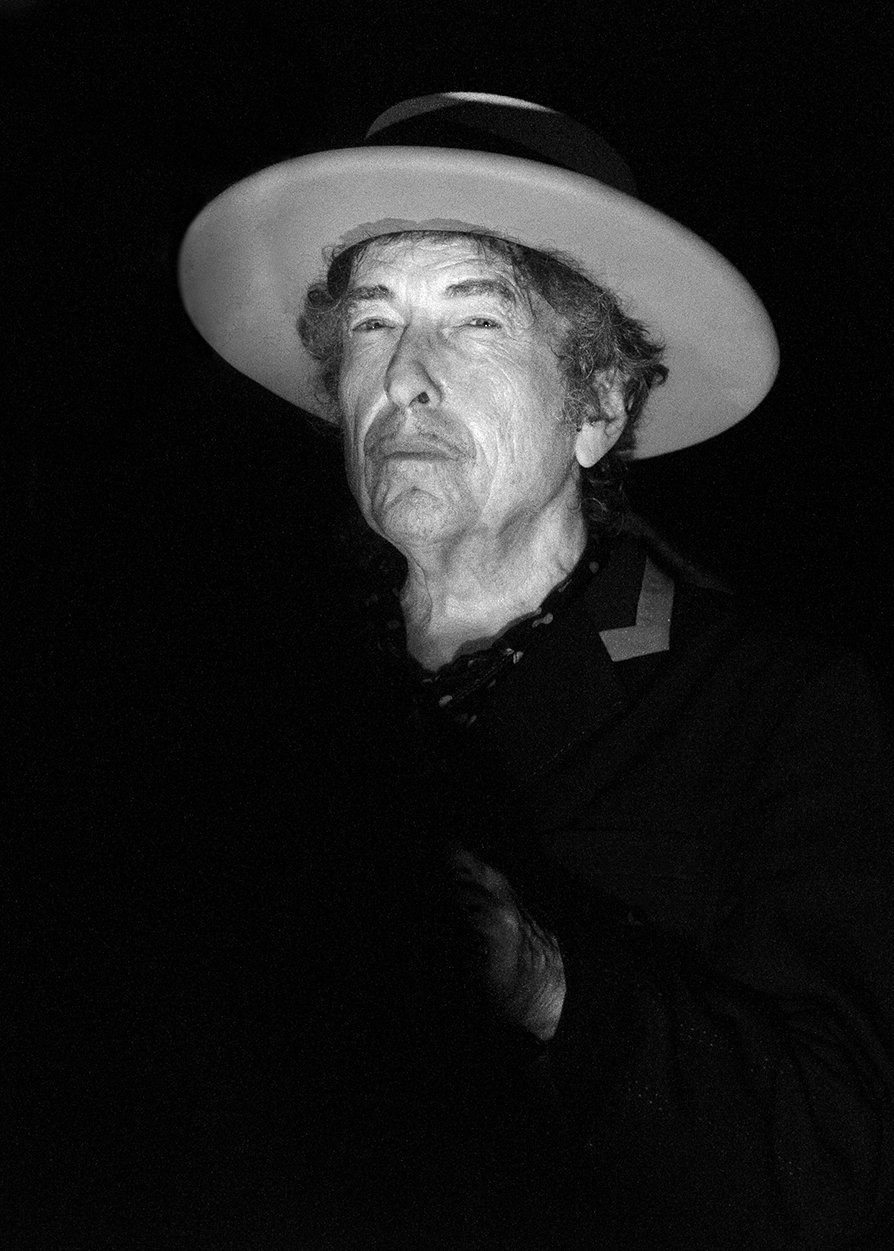
Padova 15.6.2010 © courtesy Paolo Brillo
by Vittorio Bongiorno
published in Il Foglio, November 7, 2026
“Abandon your phones, ye who enter here,” someone says as they snap one last selfie at the entrance to Milan’s Unipol Dome, handing their phone over to the diligent security guards. Inside, it’s not exactly hell, but it’s the first of Bob Dylan’s three Italian concerts (then Rome, and the last one on Saturday, the 7th, in Bologna). The ban on cell phones, cameras, and smart glasses has irritated the die-hard fans of the minstrel from Duluth, Minnesota, and although the promoter has threatened to escort violators out of the venue, the 15,000 loyal fans are making do as best they can, pulling out camping binoculars, toy telescopes, and plastic cameras to capture a few images. The concert by Robert Allen Zimmerman, born on May 24, 1941, better known as Bob Dylan, is unlike any other. Three years after his last Italian tour, and at the ripe old age of 85, the rock poet’s audience is ready for anything: songs transformed beyond recognition, limping arrangements designed to avoid sing-alongs and the infuriating clapping, and absolute silence between songs. But above all, they’re ready to challenge the guardians of the threshold, as if on a rite-of-passage journey into the deepest cave to retrieve the talisman of an image—even a blurry, grainy, or poorly lit one—and return with the elixir.
After the liturgy of subtraction at the entrance, my son—a Dylan fan since he was a toddler—and I wait with bated breath alongside the congregation, defenseless and exposed before a stage set even more bare than on other occasions, all of us speaking in hushed tones as if we were in a church.
At nine o’clock sharp, the musicians appear on stage, and strumming as if they were undecided about how to begin. An unexpected rock and roll backing track kicks in, along with a few sparse solos, and just as suddenly, from the opening in the backdrop curtain, a small figure hooded in black emerges and takes his place behind the piano: Bob Dylan begins to sing what the older folks, with some effort, recall as “Watching the River Flow,” a 1971 song he played extensively in the ’80s with Jerry Garcia’s Grateful Dead and which he has often used as the opener for his recent concerts. The meaning behind this choice seems clear: tonight, despite the conductor’s age, we’re dancing to rock and roll tinged with blues and with an aftertaste of whiskey and fried chicken.
And it also becomes clear why two guitarists—who quietly joined the band at the end of June and are well known to roots music fans—are on stage: Julian Lage, a 38-year-old Californian and former child prodigy of jazz guitar, plays alongside Bob, and on the other side of the stage is fiftysomething Joel Paterson, one of the pillars of the Chicago blues and rockabilly scene. Both are unassuming figures, dressed elegantly, yet with effervescent musical personalities and blazing guitars; they weave in and out of the loose-limbed piano phrasing played by the bandleader, with delightful flashes of brilliance, backed by the impetuous drumming of the veteran Anton Fig. In the center of the stage isn’t Bob, as the woman sitting next to us thinks, but his shadow, Tony Garnier—wearing a black hat and a mustache straight out of a Western movie—who, with his electric bass (which he alternates with the double bass), has been guiding Dylan’s music since 1989, accompanying him in more than 3,000 shows around the world. No sooner have we settled into the rhythmic and cheerful opening than, almost without pause, the band launches into a broken, hypnotic rhythm: I immediately recognize “Love Sick,” one of the masterpieces of the ’90s, a ballad about desperate love. Just as desperate is Dylan’s singing, as he tackles the song with a broken voice, sometimes slightly behind or slightly ahead of the beat, chased by the audience that wants to sing along but can never quite catch up. Lage and Paterson dart in and out in a flash, making the ballad even darker and more foreboding.
“I’m walking through streets that are dead, walking, walking with you in my head. My feet are so tired, my brain is so wired. And the clouds are weeping. Did I hear someone tell a lie? Did I hear someone’s distant cry? You thrilled me to my heart, then you ripped it all apart. You went through my pockets when I was sleeping. I’m sick of love… but I’m in the thick of it. This kind of love… I’m so sick of it”
The applause is thunderous from the very beginning and remains so until the end, even amid the constant shifts in tempo and atmosphere that make the music elusive, and despite the fact that the arena’s sound system is totally unsuitable for such a refined concert. Some people even leave after an hour because they can hardly hear anything from Section C, and many look around, bewildered, because they don’t recognize a single song and wish they were somewhere else. The setlist alternates between songs drawn from his vast repertoire spanning the ’60s, ’70s, and ’90s, all the way to the monumental 2020 album “Rough and Rowdy Ways”: by constantly finding new ways to subvert the performance, Dylan stretches time and space at will. The music is stripped down to its bare essentials, played ever more softly to keep an increasingly fragile, yet sweeter, voice afloat. Even historic and world-famous songs like the folk song “Tangled Up in Blue”— yet another tale of lost love, from the 1975 masterpiece “Blood on the Tracks”—are transformed tonight into a lullaby, a droning chant for solo piano and voice, with a few measured touches from the two guitars. Dylan, the prophet, changes the lyrics, switching the female protagonist to a male one: a mistake, an oversight, or a reversal of roles in a world crumbling like sand between one’s fingers?
“She turned around to look at me, as I was walkin’ away. I heard her say over my shoulder, We’ll meet again someday on the avenue. Tangled up in blue”
A couple of times, from beneath his hood, he gives a nod to guitarist Lage, but doesn’t even look at him—like a conductor leading an orchestra without being seen. Hidden beneath the hoodie—the same one he wore a few days ago during his visit to the Vatican to see Pope Leo XIV—there could very well be another Robert Allen Zimmerman, an alien, a stranger. And yet, according to those who’ve had the good fortune to meet him, this very measured gesture of appreciation toward the young musician is quintessentially Dylan-esque: a mountain that watches you and that you try, and fail, to grasp, because it is insurmountable, and its gaze has already moved elsewhere.
My son, whom I’ve had listening to this music since he was little, asks me at one point, “What kind of music is this? How would you describe it?” Good question. The music performed on stage tonight is undoubtedly a product of rock and roll and the blues—drawn as much from the protest songs of his spiritual father, Woody Guthrie, as from his other patron saint, Little Richard. When the wild performer of “Tutti Frutti” died in 2020, Bob broke his age-old silence to declare that Little Richard had been “my shining star and guiding light back when I was only a little boy. His was the original spirit that moved me to do everything I would do.” That’s why, watching him tonight play the electric piano with jittery energy, everything seems clearer. The other element that has constantly shaped his music is the path he has relentlessly traveled on his fabled “Never Ending Tour.” His friend, the great guitarist Robbie Robertson, described what they were doing in the 1960s as “street music. We all come from the street”—whether it’s the street sung about by Bob in his most famous songs or the one he physically traveled starting on April 11, 1961, in New York’s Greenwich Village, at his live baptism. Sixty-five years later, Bob is still on the road, almost every night, with a cracked voice, a battered body, and a sharp gaze—sometimes piercing, often moving.
In the dark, we spot someone who has managed to sneak past security and is taking a photo from a distance. The master of these “stolen shots” is undoubtedly Paolo Brillo, the well-known accountant from Bolzano, a devoted Dylanite, who for more than forty years has managed to bypass metal detectors and security to capture all the rock stars from his seat in the stands of theaters and stadiums—from the Rolling Stones to Patti Smith, from Bruce Springsteen to Neil Young. But Bob is his first love, and in 2020 he dedicated the book “Bob Dylan: No Such Thing as Forever” to him. His photos of Dylan—of exceptional quality and taste—have been published over the years by The New Yorker, Uncut, and Le Soir, and before the concert began, he told me about his 2014 meeting with Jeff Rosen, Bob’s longtime manager, in Dylan’s New York office: “I started photographing him in ’84 on 35mm film at the Verona Arena. Then in Milan, London, Paris. I must have over ten thousand photos of him. But I felt like a complete schmuck sitting in Bob’s office with copies of the new album that was set to come out the following year, his hats, his personal belongings. Rosen, his right-hand man, walked in and said to me, ‘We know you well. But how do you manage to take these photos without ever getting caught by our security?’ I didn’t tell him, because otherwise it would have been the end for me,” Brillo says with a laugh.
“Rosen really liked the photos,” Brillo continues, “but he makes it clear: ‘If it were up to me, I’d put the book out right away, but he’s the boss, and everything that comes out of here—whether it’s a pin or a poster—has to be approved by him.” The photographer admits that it took years for the book to be approved by “the boss”—who’s perpetually on the road—and after the first print run for the British publisher Red Planet Books, Brillo is now working on a new, updated version featuring his most recent shots and a new design. I ask him what he’d say to him if he ever met him, and he replies slyly: “I’d tell him, ‘I’m that schmuck who’s been secretly photographing you for forty years!’”
Another Dylan fan is Bennyboy, the stage name of an English musician who cleans up and masters the amateur recordings he magically finds online, making them available to fans for free. He tells us that he’s been seeing Bob live only since 1995, but he’s produced over 650 bootlegs—those “ghost” recordings that take their name from the bootlegging of alcohol during American Prohibition. “I’ve never had any problems with management or the record label, for which I’m grateful. Probably because I don’t make any profit from my work and I don’t do it professionally—only for the fans,” continues Bennyboy, whose mission is “for as many people as possible to be able to listen to the works of this incredible artist with the best possible audio quality.”
As Dylan has taught us for more than sixty years, true transgression is being yourself, and freedom lies outside the box and beyond the rules.
The hour-and-a-half concert flies by without anyone receiving a notification or an email, and the only thing that grows during that stretched time was the desire to dance, to embrace one another, to let loose.
After the first verse, it’s my son again who recognizes the anthem of freedom, “I Shall Be Released,” with which Bob decides to bid us farewell: a sweet and sorrowful gospel ballad about a man who, through a wall, hears the screams of a cellmate who’s been framed. Dylan recorded it during a home session in Woodstock, where he had retreated after his mysterious motorcycle accident in 1966. That version, released only on promotional copies, began to fuel the more or less illegal bootlegs throughout his career, and it is also the last song sung by Dylan, Robbie Robertson, Ringo Starr, Joni Mitchell, and many other guests in Martin Scorsese’s 1978 documentary masterpiece “The Last Waltz.”
“Now, yonder stands a man in this lonely crowd, a man who swears he's not to blame. All day long I hear him shouting so loud, Just crying out that he's been framed. I see my light come shinin', from the west down to the east. Any day now, any day now I shall be released”
Once outside, the Milanese night welcomes us, and we exchange a sign of peace. Some people are still grumbling that they didn’t recognize a single song; others complain that all they saw was an arrogant, unfriendly hooded figure. One person says he saw him limping, which is why he never moved. Many remain silent, but fortunately, a few others are happy: “It’s incredible how Bob set his ego aside to let the musicians around him shine,” says my son, thanking me once again for the wonderful gift. I run into journalist Gianni Sibilla, a guy who’s seen Dylan live fifteen times, and he confesses that this finale moved him: “A little tear rolled down my cheek—I didn’t expect it. It’s music in its purest form. Seeing him is a privilege. He plays practically every night, doing it his way, whenever he wants, without worrying about ratings, without making concessions. And I find that wonderful.” We turn our cell phones back on and return to normal life—made up of notifications, fleeting messages, and links in bios. Under a streetlight, some girls spot Lucio Corsi, who “wanted to be a tough guy,” as the title of his hit goes, and ask him for a selfie: at least he won’t say no.
On the bus taking us home, everyone is listening to Dylan on their devices, and the lyrics to “False Prophet”—which Bob sang just before closing—echo in my mind: “I’m the enemy of treason—the enemy of strife, I’m the enemy of the unlived meaningless life, I ain’t no false prophet—I just know what I know, I go where only the lonely can go.” Only the lonely—that’s him.