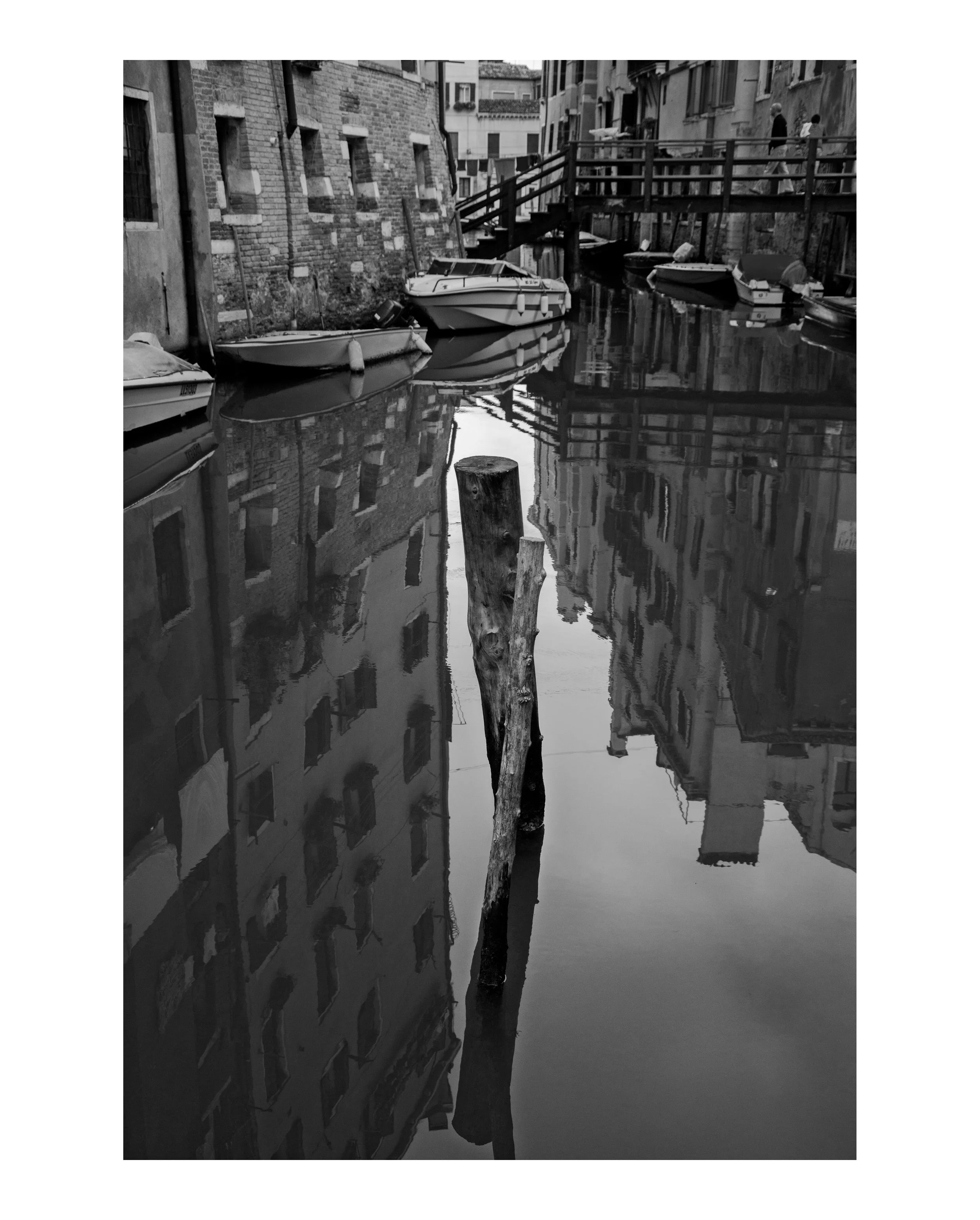
photo courtesy of Ferdinando Scianna
published by Il Foglio, 5.9.2026
Scianna and Emma Dante with Buttafuoco in Venice: photography and theater in a city whose history has never grown old
by Vittorio Bongiorno
Venice is a mirror, a fish when viewed from above, and so the best way to arrive would be from the sea, as Thomas Mann suggested. It’s almost as if arriving in the lagoon city were an experience, a rite, rather than a stop on a tourist itinerary: water, a primordial tangle of islands, gold, embroidery, stones smoothed by the waves, fierce seagulls, and shadows concealing destinies. In this port city—a sweet and bewitching trap, foul-smelling yet resplendent—three wandering Sicilians have landed: travelers and voluntary exiles, not for tourism but for work, for an award, for government service: Ferdinando Scianna, Emma Dante, and Pietrangelo Buttafuoco. The first with an exhibition on the Jewish Ghetto, right inside the Campo del Ghetto Nuovo; Emma Dante, who received the Golden Lion for Lifetime Achievement at the start of the summer; and Buttafuoco, who is the skilled helmsman of this Biennale—theater, dance, music, architecture, art, and cinema.
Three different destinations, three different ways of losing oneself in Venice—loving it and being loved by it, each in their own way. All while remaining faithful to a single island, Sicily, which, as Buttafuoco suggests, «has never known the narrow-minded logic of a cramped courtyard because, like Venice, it too has always been in the middle of the sea.»
«I have a problem with Venice», says Scianna, who recently turned 83 and has been carrying a camera slung over his shoulder for half a century, «but I don’t think I’m the only one—we all do. The city is very demanding; it’s hard to capture it without being overwhelmed by its splendor, by its charisma». The great Sicilian photographer confesses with a hearty laugh on the occasion of the exhibition “Ferdinando Scianna at the Venice Ghetto” at the historic Ikona Gallery (through November 22): «I know few photographers who’ve managed it—like my friend Berengo Gardin, through his focus on the everyday, or Campigotto, who photographed it at night in a fantastic waywho photographed it brilliantly at night. I’ve done a lot of things in Venice, but I always got carried away». That natural charisma of the city has made many lose their heads in the past—Thomas Mann, who described its ambiguous eroticism as a trap for foreigners; Iosif BrodskijJoseph Brodsky, who made his most beautiful pages shine on its waters; and Geoff Dyer, who indulged in the wildest vernissages and cocktail parties.
«The project in the Ghetto was my last photographic workmy latest photographic work. After a site visit, I had convinced myself that, deep down, it was just a square, a small neighborhood», Scianna says with bitterness, alluding to his mobility issues, which for some time have hampered his brisk pace in pursuit of the ‘decisive moment’—that fleeting glimpse of reality to be captured through the lens. The photographer had arrived in the city in 2016 for the 500th anniversary of the founding of the Jewish Ghetto and was convinced he could pull it off, given the confined topography of that “island within an island,” by narrowing his focus down to the bare essentials. Not the entire city, not the gondolas, not the bridges for lovers, but a tiny patch of land just a few hundred meters wide: «If I get tired, I’ll rest, I told myself, it’s not even a small village—it’s a neighborhood», he continues, recalling the entire month he spent in close contact with the Jewish community. “I’ve always been deeply fascinated by the people of the community, and I carried out this work with them with great pleasure—with passion, but also with difficulty. No doorbells on Saturdays, no electricity….» His laughter rings out, genuine and sincere, as he lists the rules—not so different from those learned by the young Ferdinando, who came of age photographing religious festivals and Catholic processions for his first book, “Religious Festivals in Sicily”, co-authored with Leonardo Sciascia in 1965 when he was just twenty-one years old.
«We are children of the same madness, in a sense, and for this project I spent a long time observing a place that has lived through its own story—one that is not grandiose, but full of pain, full of events and people».
Those photos, so full of life and stories, are being presented again today—ten years after the first exhibition commissioned by Fabio Achilli, Director of the Fondazione Venezia—thanks to the tireless work of gallery owner Ziva Kraus, who is the living memory of Ikona Gallery and the soul of the cultural life of a “threshold gifted to life.a “threshold gifted to life.” «I am a messenger between the artwork and the public», says this extraordinary woman poetically of herself—a Croatian-born painter who arrived in Venice as a teenager to heed an inner voice she could never escape. «I am a prisoner of Venice», she says with irony and an almost Kafkaesque sobriety after having brought half a century of international photography to the lagoon, from Berenice Abbott to Helmut Newton, from William Klein to Gisèle Freund. «Scianna’s photography transcends—literally—it casts its shadow», emphasizes the gallery owner, who, as a young woman, worked as Peggy Guggenheim’s assistant at Palazzo Venier.
Forty years after that experience—which Kraus describes as «simple, gentle, and free of pretense»—she curated the exhibition “Peggy Guggenheim in Photographs (2016)” at his Ikona Galleryat her Ikona Gallery, as a sort of homecoming to restore the city’s memory. Just as the presentation of Scianna’s photos in Venice is for Venice.
On the walls of Ikona—a small, cozy rectangle traversed by a staircase leading to an imaginary elsewhere—Scianna’s meticulous black-and-white work seems to reflect endlessly in a mirror. Venice gazing at itself, the Ghetto square mirrored within itself, a little girl on a skateboard disappearing into the shadows of the portico. That low stone portico at the gallery’s entrance is both reality and fiction, community life and an image captured on film. A minuscule forma urbis that nevertheless rises upward, given the Ghetto’s confined dimensions, as if it were a medieval city. Yet it transforms the Ghetto’s classic low-rise houses into lagoon-side skyscrapers. In the sixteenth century, four Christian guards—appointed by the Republic but paid by the Jews—were tasked with opening the gates at dawn and closing them at night, patrolling the perimeter of the Ghetto by boat.
Accompanied by Ziva Kraus, Scianna walked for a long time at the same slow pace, ready to capture faces, gestures, reflections, celebrations, and prayers. An entire humanity encapsulated in a small square. And then, at night, in a flash, one of the most dreamlike images in the exhibition appeared before him: a light on in a window and the shadow of a man smoking a cigarette as he gazed into the infinite: «It’s one of my favorites. That figure that suddenly appeared seemed to me like an apparition from history», says the photographer, who returned to the city last year as a guest of the 82nd Venice Film Festival, starring in Roberto Andò’s documentary “Il fotografo dell’ombra” (“The Photographer of Shadows”). A year later, he still recalls with emotion the audience’s reception and laughs heartily at his appearance on the red carpet: «I was really amused to be there like an actor, with my fellow photographers teasing me. It was wonderful—a great bit of fun»It was wonderful—great fun».
«I feel as if I’ve changed, but I don’t feel that Venice has changed», confesses Emma Dante, a writer, actress, and playwright from Palermo, when asked about her relationship with the city twenty-two years after her debut at the 2004 Theater Biennale with “La scimia” and following this year’s success with “I fantasmi di Basile”, a play exploring the world of the Neapolitan writer Giambattista Basile, the 17th-century author of “Cunto de li cunti” and the first great inventor of the modern fairy tale. «But since Venice is an immortal city and I, on the other hand, am utterly mortal, utterly frail in my little life, it seems to me that returning to Venice is always a bit like acknowledging—and therefore accepting—one’s own mortality», the director adds in a whisper. It was the same voice, choked with emotion, with which she read her acceptance speech at the Golden Lion ceremony—a speech she had written so that «I can focus on reading it and won’t start crying». In its citation for the award, the Biennale emphasized how, through her theater, Emma Dante has brought Sicily back into the spotlight, reinvigorating the great legacy of Pirandello, Sciascia, and Camilleri, along with Ciprì, Maresco, and Franco Scaldati.
«Art is an artistic gesture that is always connected«Art is a creative gesture that is always connected to its origins, to the people who accompany us, and above all to the bonds that tie us together», Emma Dante read at the awards ceremony. «I believe that theater has a very important social function—one of reflection and care for society—and so, for me, it is a way to make people think, to convey messages, but also, above all, for me personally to reflect on the injustices of the world».
“When I attended the performance«When I attended the performance of “I fantasmi di Basile”», says Pietrangelo Buttafuoco, president of the Venice Biennale Foundation since 2023, «in witnessing the actors’ skill and the carefully calibrated dramatic structure that Emma Dante’s direction sought to establish, I saw once again everything—absolutely everything—that constitutes the alchemical principle of theater. An archetype, something that delves deep». Buttafuoco, who has always had a very strong connection to the stage—he previously served as president of the Teatro Stabile di Catania and the Teatro Stabile d’Abruzzo—speaks of Emma Dante’s production with great enthusiasm: «In her work, I saw echoes of the ‘posteggia,’ Neapolitan street theater, in the moment when the two actors on stage, through mimicry and techniques of waiting and pause, reenacted what is characteristic of both street performers and acrobats, as well as the desperate and the starving. And, if we may say so in passing, under our breath, at one point they even reminded me of Franco and Ciccio. That is, the ones who truly managed to keep everyone glued to their seats, mouths agape—children and adults, the learned and the simple-minded, the know-it-alls and the maliciousthe know-it-alls and the mischievous. In short, the audience—made up of so many different faces—is captivated by this uniquely feminine ability to portray what lies at the origin and what awaits us in the end».
The President of the Biennale is a raging river—or rather, a sea in a joyful storm: even though it’s Sunday, he answers questions for “Il Foglio” from his office, which has two windows identical to those of a mosque, with the Grand Canal in front and the Giudecca across the way. And he recounts that when Pinault (the French entrepreneur and art collector, owner of the Pinault Collection at Palazzo Grassi and Punta della Dogana) raises the Breton flag over his museum, he sentimentally raises that of the Kingdom of the Two Sicilies in an imaginary exchange of greetings. «I live in absolute privilege, because I work every day on the Grand Canal, which is the embodiment of a history that has never grown old—that of Venice». Listening to his stories, it comes naturally to recall the verses with which his friend Franco Battiato compared Venice to Istanbul—the same palaces right on the sea, red sunsets that fade into nothingness—two sister cities sharing the same calling as a bridge between worlds and seas.
And, speaking of the success of his Biennale—among the surprises: art curated by Koyo Kouoh, theater by Willem Dafoe, music by the very young Caterina Barbieri, and architecture, in 2025, by Carlo Ratti—Buttafuoco responds with typical Sicilian understatement: «I don’t know, fazzu u me travagghiu, I just do my job» but he adds seriously that his only guiding principle is «the Biennale’s 131 years of history—that is, being a universal point of reference». The Biennale is an institution open to all peoples. And then, when asked what sound his Venice produces—the deep pulse of the city that can be heard by pressing one’s ear to its heart—he replies with a smile: «Duri i banchi», the Venetians tell me as I walk through the «“Duri i banchi,” the Venetians tell me as I walk through the calli. A warning, a lesson for me», which recalls the order given to rowers to hold fast to the benches of their ships before ramming an enemy.
«Venice is a great mirror; we see our wrinkles, the furrows of time, where we recognize ourselves as human beings», concludes Emma Dante, «it’s a different kind of water from what we Sicilians are used to. A water that speaks more of reflection than of freedom.It’s water that speaks more of reflection than of freedom. We Sicilians are accustomed to this gaze that is lost on the horizon, which no longer distinguishes things because the sea erases the future. Only the sea that blends into the sky. Venice, on the other hand, reflects who we are».
Of that magical night, when she was awarded a prize for a brilliant career—one in which her native Palermo seems, for some reason, uninterested—the director recalls «a choked voice, a powerful emotion. I remember myself as a child, receiving an important award from Mom and Dad».
All three Sicilians, once they arrived in Venice, seem to have found a home rather than just a port city. With slow but deliberate steps, Emma Dante, too, walks through the silent streets where the heels of her shoes whisper to the world: «The sound of Venice is my footsteps… it’s as if they were saying: I exist». Because Venice, as Ziva Kraus also says amid the shadows of the Ghetto’s portico, «Venice saves everyone».